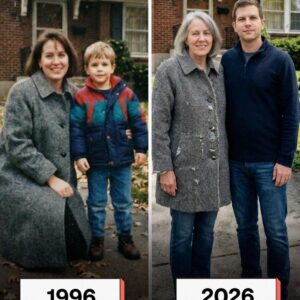
For nearly three years, the community lived with unanswered questions. A missing boy, a family that refused to give up, and a case that grew quieter with time—all combined into a long, exhausting wait. Hope never vanished, but it learned how to whisper. Then came a call. A discovery in a remote place few had thought to search. And suddenly, the long vigil shifted into something no one had fully allowed themselves to imagine.
When officers escorted the boy into view, the reality of the moment took time to register. What the family had lived with for years—fear, uncertainty, grief suspended without closure—collapsed and reassembled all at once. The embraces were instinctive and tight, held a second longer than usual, as if letting go might undo what had just been restored.
Neighbors gathered quietly along the street. Some cried openly. Others stood still, hands pressed to their faces, absorbing the weight of a story they had followed for so long without knowing how it would end. There was no cheering, no spectacle—only a shared understanding that something fragile and extraordinary had occurred.
The moment did not erase the years that came before it. Those years mattered. They shaped a family’s endurance and a community’s patience. But the boy’s return reframed them, offering a different ending than many had prepared themselves for.
In a time when missing-person cases often close with loss or uncertainty, this one arrived with relief—tempered by the knowledge of what had been endured. It was not a miracle in the cinematic sense, but something quieter and harder-earned: persistence rewarded, hope justified, and a life brought back into the circle that had never stopped waiting.
For the family, the road ahead will include healing, not just reunion. For the community, the moment will linger as proof that waiting, even when it hurts, is sometimes worth the cost.